
For wholesale buyers, a clear mommy bag production process means predictable production cycles and consistent quality—you can accurately plan inventory and avoid delays caused by vague workflows.
For custom buyers, grasping this process allows you to put forward more precise demands, such as specific craftsmanship (e.g., waterproof stitching) or material combinations (e.g., eco-friendly fabric with leather trims), and better understand the origins of “customization costs” (e.g., additional expenses for unique die-making or hand-embroidered logos).
Our Brand Position: Transparency as the Foundation of Trust
At the core of our service is transparent production—it’s a testament to our confidence in quality and the cornerstone of long-term partnerships with clients. As we always say, “Every mommy bag is polished by both standardization and craftsmanship.” In the field of mommy bag production process, we are committed to providing global clients with high-quality, personalized products.
1. Confirming Customization Intentions and Material Preparation
Once you decide to customize a mommy bag, we start with in-depth communication to accurately capture your needs: style, functionality, material, size, color, logo, and more. For example, if you require a waterproof mommy bag suitable for outdoor activities, we will recommend appropriate waterproof fabrics (such as TPU-coated nylon) based on this demand.
After clarifying requirements, our procurement team acts quickly to source high-quality materials. From outer fabrics, linings, zippers, buttons to decorative accessories, all undergo strict screening. Not only must materials meet your functional and aesthetic requirements, but they also pass our internal strict quality inspections. Some materials are required to comply with international environmental standards, such as OEKO-TEX® certification, to ensure safety for mother and baby use.
2. Pattern Making and Sample Presentation
While materials are being prepared, our experienced pattern makers carefully create paper patterns based on your customization needs. The paper pattern serves as the blueprint for mommy bag production, precisely marking the shape, size, and position of each component. Its accuracy directly affects the fit and quality of the finished product.
After pattern making, we move to sample production. Skilled craftsmen handcraft samples using selected materials, following the paper patterns strictly. Every detail—from stitch type to accessory installation—adheres to high standards. The completed sample undergoes a comprehensive quality check, including size measurement, function testing, and appearance review, to ensure it meets both your requirements and our quality standards.
The sample is then delivered to you for confirmation. If physical confirmation isn’t needed, we provide detailed photos and videos. We highly value your feedback and optimize the sample based on your comments until you’re fully satisfied.
3. Die Making and Cutting Preparation
Once the sample is confirmed, mass production begins. First, we create dies, which are precision-made based on the paper patterns. Dies are used for bulk cutting of fabrics and accessories, ensuring cutting accuracy and consistency across all pieces.
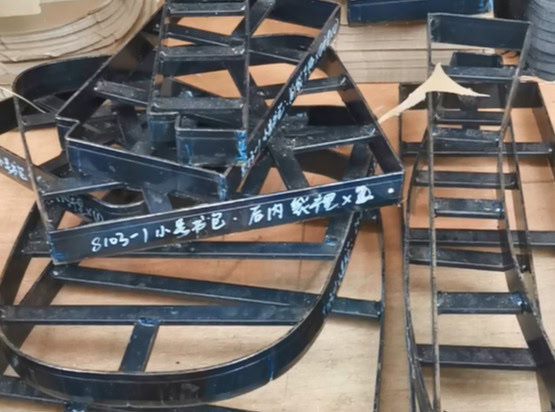
Meanwhile, the bulk rolls of fabric arrive at the factory, entering the cutting stage. Professional cutters use the dies and specialized cutting equipment to precisely cut the fabric into the required component shapes and sizes. During cutting, we strictly control fabric grain direction and color differences to ensure consistency in the same batch of products. The cut fabric components are sorted, labeled with clear numbers and information, making it easy to retrieve them in subsequent production stages.
4. Advancing Mommy Bag Production Process
(1) Pre-Sewing Preparation
Before formal sewing, fabric components undergo preprocessing. For example, some edges are overlocked to prevent fraying; interlining is glued to specific areas to enhance fabric stiffness and durability.
We also prepare all sewing supplies—threads, zippers, buttons, etc.—and preprocess them according to design requirements, such as zipper assembly and button hole punching.
(2) Sewing Process
- Component Sewing: Skilled sewers first sew small components according to technical requirements. For instance, when making pockets, they precisely control the size, position, and shape to ensure practicality and aesthetics. During sewing, appropriate stitch types and thread density are used to guarantee seam strength and neatness. For components with special functions, such as insulated bottle pockets, specific insulation materials and sewing techniques are applied.
- Main Body Assembly: After sewing small components, the main bag body is assembled. Each sewn component is accurately joined according to the design drawings, using double or multiple threads to enhance joint strength and durability. Special attention is paid to seam treatment to ensure flatness, neatness, and compliance with quality standards.
- Decoration and Function Addition: If your customization includes embroidery, printing, or gold stamping, or special functional accessories like stroller hooks or USB charging ports, these are added after main body assembly. For embroidery, we pre-adjust machine parameters based on your design files to ensure accurate thread colors, pattern positions, and sizes. For printing and gold stamping, temperature, pressure, and time are strictly controlled to ensure clear, long-lasting patterns. Special functional accessories are installed to ensure reasonable positioning, firmness, and no impact on the bag’s overall functionality or appearance.
5. Bag Closing, Seam Concealment, and Quality Inspection
(1) Bag Closing
After completing main sewing, decoration, and function addition, the bag is closed. The front and back panels, bottom, and other components are finally stitched together to form the complete bag shape. During this process, we carefully check component alignment and seam quality to ensure symmetry and integrity. The internal structure is also organized to ensure pockets and compartments are correctly positioned without misalignment or distortion.
(2) Seam Concealment
For areas requiring hidden seams or enhanced structural stability, seam concealment is performed. For example, at the junction of the bag’s bottom and sides, seams are hidden inside the fabric—this not only improves aesthetics but also strengthens the joint. This process demands precision to ensure even, flat seams with no exposure or loosening.
(3) Quality Inspection
- Appearance Check: The finished mommy bag undergoes a thorough visual inspection. We check for fabric flaws (e.g., color differences, stains, snags), neat and secure seams (no skipped or broken threads), clear and complete decorative processes (e.g., full embroidery, non-peeling prints), and firm, accurately positioned accessories (e.g., smooth zippers, secure buttons).
- Size Measurement: Using professional tools, we strictly measure all dimensions—length, width, height, strap length, etc.—to ensure they match your customization requirements and design drawings, with minimal error.
- Function Testing: Practical tests are conducted on all functions. We check the usability of pockets and compartments, the smoothness of zippers/buttons/buckles, and for special features (e.g., waterproofing), we perform simulated waterproof or immersion tests to ensure compliance with standards. For bags with stroller hooks, load-bearing tests are done to confirm accessory safety and reliability.
Any product failing inspection is immediately sent back for rework. Only products passing strict quality checks proceed to the next stage.
6. Accessory Installation, Packaging, and Delivery
(1) Accessory Installation
After passing quality inspection, final accessories are installed—such as strap adjusters, shoulder straps, and nameplates. We ensure accessories are firmly attached, accurately positioned, and coordinated with the bag’s overall style. A final check is done to confirm no missing or damaged accessories.
(2) Packaging
Based on your requirements and product characteristics, we choose appropriate packaging. For regular wholesale orders, we use simple dust bags and standard cartons to protect products from dust and impact during transportation. For clients needing custom brand packaging (e.g., color boxes or tags with your logo), we produce packaging according to your design files. Packaging focuses on both protection and presentation to ensure the product arrives in perfect condition.
(3) Delivery and After-Sales Service
Packaged mommy bags are shipped promptly via your chosen method—sea freight, air freight, or express. After shipping, we provide logistics tracking information so you can monitor delivery status. We also offer comprehensive after-sales service: if you find quality issues or have questions upon receipt, we respond promptly to resolve them, ensuring your satisfaction.
Through this rigorous, detailed, and efficient customization process, we strive to create high-quality mommy bags that meet the needs of every international client. With professional production capabilities and service attitude, we aim to earn your trust and build long-term partnerships. The mommy bag production process is more than a workflow—it’s our commitment to quality, transparency, and your success.

If you would like to learn more about our quality inspection process, you can read this article《Diaper Bag Quality Control: Our Comprehensive Process at Wonder Company》.
Recent Posts
- Is RPET Fabric Reliable for Mommy Bags? A Comprehensive Guide for Brands & Wholesalers
- How to Choose the Right Buckle for Your Diaper Bag: A Guide to Safety, Durability, and Design
- Why Is It Called a Diaper Bag? Insights from Supplier
- Do We Really Need a Diaper Bag? A Business Analysis for B2B Partners
- CBME 2025 Global Trends Whitepaper: China’s Maternal and Infant Supply Chain Innovation and Opportunities for Overseas Partners